CNC Turning
Live-tooling lathes and mill-turn centres for complete parts off one machine
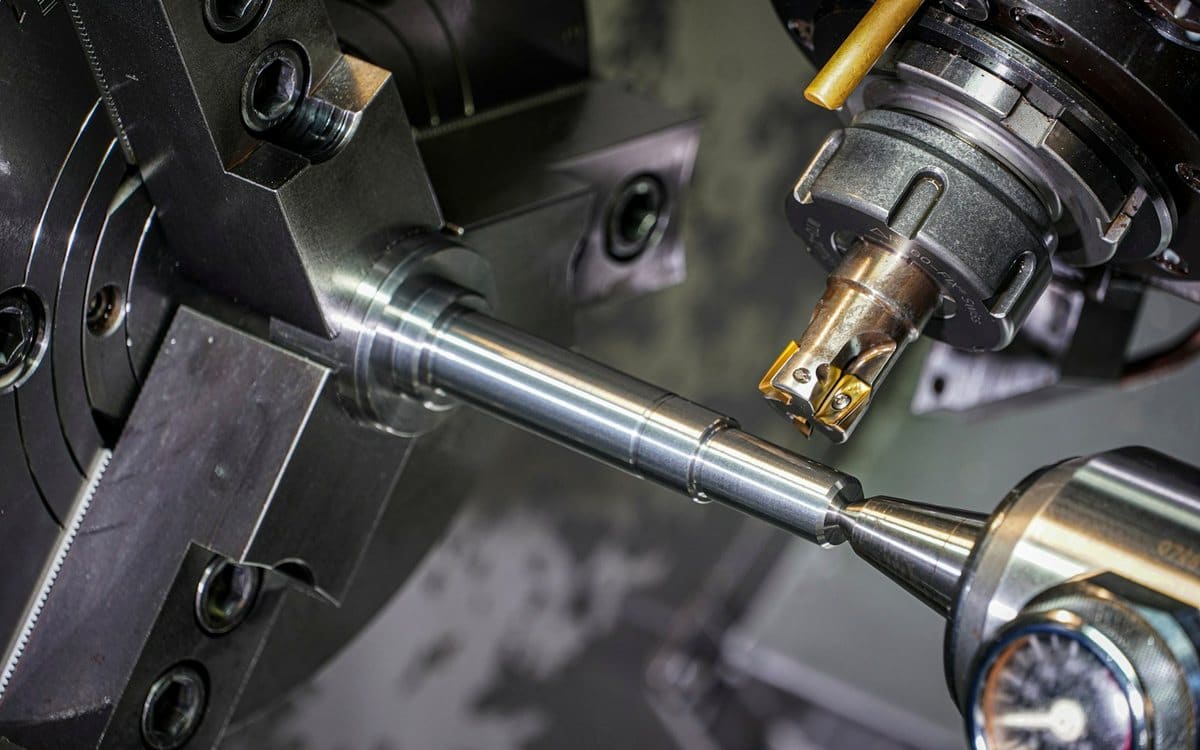
CNC lathes with driven tools, Y-axis and sub-spindles produce shafts, bushings, fittings and flanges complete in a single cycle — turning, milling, drilling and threading without a second operation.
One cycle, finished part
Threads that seal
Bar-fed, lights-out capable
Why it works
One cycle, finished part
Sub-spindle transfer machines the back face without a second setup, eliminating the run-out and handling damage that reworking introduces.
Threads that seal
Metric, UNC/UNF, BSP, NPT and trapezoidal threads gauged with go/no-go plugs and rings, and pressure-tested on request up to 350 bar.
Bar-fed, lights-out capable
Automatic bar feeders and parts catchers run unattended shifts, which is what keeps unit cost competitive on batches above 500 pieces.
Process specification
| Max turning diameter | 400 mm (15.7 in) |
|---|---|
| Max turning length | 1200 mm (47 in) |
| Bar capacity | 4 – 80 mm |
| Diameter tolerance | ±0.008 mm |
| Concentricity | 0.01 mm TIR |
| Standard surface finish | Ra 1.6 µm / 63 µin |
Tighter tolerances than those listed are achievable on review — please mark critical dimensions on your drawing.
Turned parts, complete off the machine
A part that leaves the lathe finished is a part that cannot be damaged, mixed up or mis-located in a second operation. Our turning cell is built around that principle: driven tooling, Y-axis and sub-spindle transfer let us face, turn, mill flats, cross-drill, tap and part off in one cycle.
Bar-fed machines run diameters from 4 mm to 80 mm; chucker work extends to 400 mm diameter for flanges, end caps and large adapters.
Concentricity, roundness and finish
Concentricity is held to 0.01 mm TIR on parts turned between spindles, and to 0.005 mm where a single chucking and a follower rest can be used. Roundness on ground-bar stock is typically within 0.005 mm.
Standard turned finish is Ra 1.6 µm. Ra 0.8 µm is routine on stainless and brass with a finishing insert and controlled feed; Ra 0.2 µm and below is reached by adding hard turning or cylindrical grinding.
Threads and sealing features
We cut metric, UNC/UNF, BSP, NPT and trapezoidal threads, and roll threads where fatigue strength matters. O-ring grooves are cut to ISO 3601 or to your drawing dimensions, with the corner radii and surface finish that make the seal work rather than merely fit.
Inspection of turned features
Diameters are monitored with calibrated micrometers and air gauges through the run; critical bores are verified with bore gauges traceable to national standards. Where a drawing calls for it, we supply a full dimensional report with actual measured values for every characteristic, not a pass/fail tick.
Frequently asked
How quickly will I receive a quotation?
Most quotations are returned within 24 working hours. Simple turned or milled parts are often priced the same day; assemblies, multi-process jobs and requests requiring a material enquiry may take up to two working days. If a quotation will take longer, we tell you when to expect it rather than leaving you waiting.
What files do you need to quote?
A 3D model in STEP, Parasolid (X_T) or IGES is enough to start. Where the part carries tolerances tighter than ISO 2768-m, GD&T, surface finish callouts or thread specifications, please add a dimensioned 2D drawing as PDF or DWG. Telling us the quantity, material and required finish avoids a round of questions and usually gets the price back the same day.
Is there a minimum order quantity?
No. We machine single prototypes as readily as 20,000-piece releases. There is a minimum order value on very small jobs to cover setup and programming, which we state clearly in the quotation — there are no charges that appear later.
What actually drives the price of a machined part?
Four things, roughly in order: the number of setups, cycle time, material cost and the tightest tolerance on the drawing. A tolerance of ±0.01 mm where ±0.1 mm would function can add 30 % to the price, and a feature that forces a fourth setup can add more. Our quotations flag these drivers so you can decide whether the requirement is worth the cost.
Need this process for your part?
Send your drawing and we will confirm feasibility, cost and lead time.
- Reviewed by a manufacturing engineer
- NDA available before file exchange