Sheet Metal Fabrication
Laser cutting, CNC bending, welding and assembly for enclosures and brackets
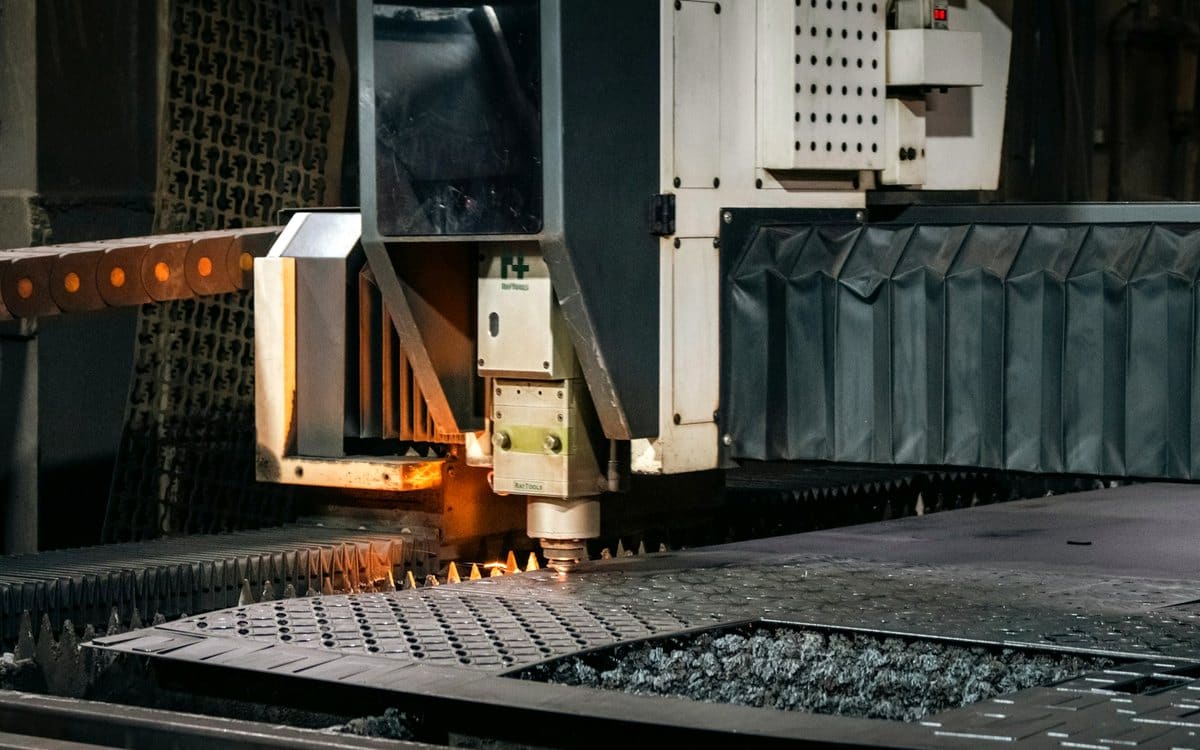
Fibre laser cutting, CNC press braking, punching, TIG and spot welding, and hardware insertion — the complete route from flat sheet to a finished, painted, assembled enclosure.
Correct K-factor, first time
Enclosures shipped complete
Nesting that respects your budget
Why it works
Correct K-factor, first time
Flat patterns are unfolded with a bend-deduction table verified per alloy and thickness, so the finished box matches the model instead of growing 1 mm per bend.
Enclosures shipped complete
Powder coat, hardware, gaskets, glands and silk-screen are done before shipping, so what arrives goes straight onto your assembly line.
Nesting that respects your budget
Parts are nested across the full sheet and, where you order families together, across your whole order — material utilisation above 85 % is typical.
Process specification
| Max sheet size | 3000 × 1500 mm |
|---|---|
| Steel thickness | 0.5 – 12 mm |
| Aluminium thickness | 0.5 – 8 mm |
| Cut tolerance | ±0.1 mm |
| Bend angle | ±0.5° |
| Max bend length | 3200 mm |
Tighter tolerances than those listed are achievable on review — please mark critical dimensions on your drawing.
From flat pattern to finished assembly
Sheet metal work is a different discipline from machining, and treating it as such is what keeps cost down. We unfold your 3D model with the correct K-factor for the alloy and thickness, nest parts to minimise scrap, and cut on fibre lasers that leave an edge clean enough to paint without secondary dressing.
Bending is programmed offline against a verified tool library, so the first part off the brake is within tolerance rather than the third.
Materials and thickness
Mild steel to 12 mm, stainless steel to 8 mm, aluminium to 8 mm, copper and brass to 4 mm. Pre-galvanised and pre-painted sheet is handled where the finish must survive the process.
Joining and hardware
TIG, MIG and spot welding with weld maps for repeatability; PEM-style self-clinching nuts, studs and standoffs inserted on a CNC insertion press. Welds are dressed and blended where the drawing calls for a cosmetic finish.
Finishing and assembly
Powder coating in RAL colours, wet paint, anodising, zinc plating, passivation and silk-screen or laser marking. We ship assembled enclosures with gaskets, EMC shielding, cable glands, hinges and latches fitted, tested and packed for direct integration.
Tolerances worth designing around
Bend angle is held within ±0.5°, bend-to-bend dimensions within ±0.2 mm, and cut profiles within ±0.1 mm. Cumulative tolerance across a multi-bend part grows with each bend — mark the datum face on your drawing and we will work from it.
Frequently asked
How quickly will I receive a quotation?
Most quotations are returned within 24 working hours. Simple turned or milled parts are often priced the same day; assemblies, multi-process jobs and requests requiring a material enquiry may take up to two working days. If a quotation will take longer, we tell you when to expect it rather than leaving you waiting.
What files do you need to quote?
A 3D model in STEP, Parasolid (X_T) or IGES is enough to start. Where the part carries tolerances tighter than ISO 2768-m, GD&T, surface finish callouts or thread specifications, please add a dimensioned 2D drawing as PDF or DWG. Telling us the quantity, material and required finish avoids a round of questions and usually gets the price back the same day.
Is there a minimum order quantity?
No. We machine single prototypes as readily as 20,000-piece releases. There is a minimum order value on very small jobs to cover setup and programming, which we state clearly in the quotation — there are no charges that appear later.
What actually drives the price of a machined part?
Four things, roughly in order: the number of setups, cycle time, material cost and the tightest tolerance on the drawing. A tolerance of ±0.01 mm where ±0.1 mm would function can add 30 % to the price, and a feature that forces a fourth setup can add more. Our quotations flag these drivers so you can decide whether the requirement is worth the cost.
Need this process for your part?
Send your drawing and we will confirm feasibility, cost and lead time.
- Reviewed by a manufacturing engineer
- NDA available before file exchange